RU A.4
Chloride-Ion Batteries in
POLiS II
Chloride-based batteries have emerged as promising candidates for energy storage systems beyond lithium. In this Research Unit, our goal is to build a solid scientific foundation for chloride ion shuttle chemistries and to expand the set of materials available for anionic cell concepts. By accelerating the development of suitable cell components and developing first full cells, we aim to advance the chloride-based systems and bring them up to the standard of well-established cation cell concepts.
Systems based on anionic shuttling have the potential to increase the capacity and energy density of batteries, while at the same time resource issues may be mitigated. However, only a small range of suitable electrode materials and electrolytes exists to date. In POLiS, we design and synthesize new active materials capable of chloride ion shuttling to broaden the range of components suitable for full-cell applications. We screen and evaluate novel material compositions that range from metals to organic materials employing theoretic modelling in combination with experimental studies with the aim to derive general design principles based on structure-property relationships. To address the challenges of dissolution and corrosion of active material in the electrolyte, we develop advanced liquid and (semi-)solid electrolytes that could significantly improve cycle life. In the process of selecting and optimizing components for a chloride ion full cell, sustainability including life cycle assessment is a key criterion. Along with the exploration of novel materials, this includes the optimization of previously established systems.
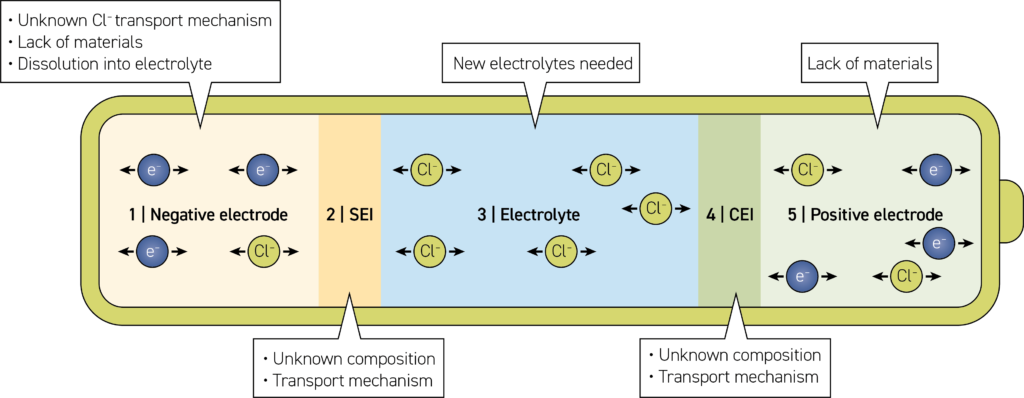
Along the chloride ion pathway, we characterize the composition of electrode-electrolyte-interfaces, unknown at the current stage, and the spatial and depth-distribution of species in the interphases. We employ advanced analytical tools to identify charge/discharge mechanisms in the cell and to elucidate underlying insertion and conversion reactions along with possible degradation pathways. Within the bulk of the electrode, we further analyze the chloride ion transport. Investigation of charge transfer processes occurring at the electrode-electrolyte-interfaces further allows us to create a knowledge basis of chloride ion batteries and to compare anionic with cationic battery systems.