RU A.3
Multivalent Batteries in
POLiS II
Cell concepts based on multivalent ions contribute to an increasing diversity of energy storage technologies. In this Research Unit, we focus on magnesium, calcium or aluminium-based ions as charge carriers for rechargeable batteries, while equally investigating magnesium, calcium and aluminum metals as negative electrode materials for battery applications. These elements promise high energy densities and are highly abundant in the earth crust. Following the path of the multivalent ions through the cell, our goal in this Research Unit is to address the challenges of their high charge density and associated limited mobility towards full cell concepts.
To advance multivalent battery cells, we work on the development of stable and scalable electrodes capable of efficiently storing multivalent ions, as these represent one of the main components in the cell. To this end, we explore both insertion-type and coordination-type materials as positive electrodes, while focusing on multivalent metals and their microstructure, morphology and surface properties as negative electrodes, with the goal to establish optimal electrode compositions with enhanced energy densities. This also includes improving the environmental footprint of the syntheses and electrode preparation processes, as well as investigating potential recycling concepts. By designing next-generation liquid and (semi-)solid electrolytes, and by optimizing state-of-the-art concepts, we aim to enable reversible and fast ion movement through the cell.
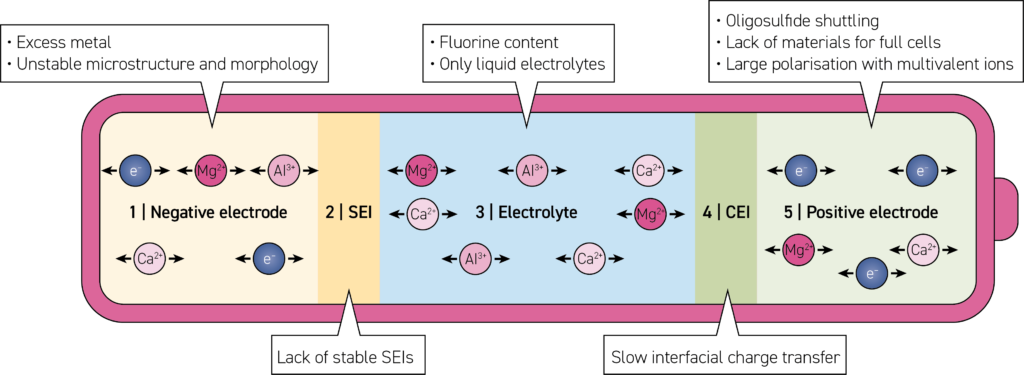
We further investigate electrode–electrolyte interfaces, interphases and charge-transfer mechanisms which are essential for a fundamental understanding of multivalent ion mobility within the cell. Through our studies, we aim to uncover how the nature of multivalent ions, including their ionic radius, charge density, (de)solvation energy and coordination chemistry, affects battery performance along the ion’s path to and from the electrodes. In our facilities, we incorporate these findings into the optimization of all cell components, combining materials science, electrochemistry and computational methods while taking sustainability into account.
How does a Magnesium Battery work?
You are currently viewing a placeholder content from Default. To access the actual content, click the button below. Please note that doing so will share data with third-party providers.
More Information