Research Data
Research Data Management in the Cluster of Excellence POLiS
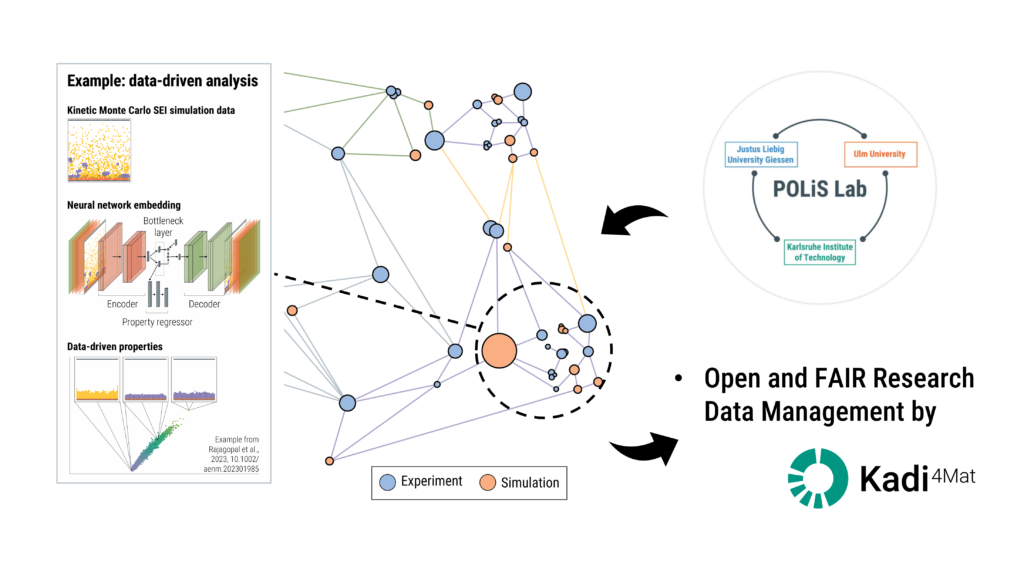
The responsible management of research data is an important component of scientific excellence at POLiS. Our interdisciplinary groups generate complex datasets spanning experimental results, computational modeling, and engineering data. The RDM strategy at POLiS is designed to reduce the administrative burden on researchers by providing tools that support automated documentation and ensure data integrity. This approach establishes an advanced research environment that combines state-of-the-art infrastructure with tailored institutional support. By ensuring data is structured and machine-readable from the start, the Cluster enables the use of AI, machine learning, and automated discovery to accelerate the transition from laboratory results to functional energy storage applications. Dedicated data stewards act as the essential bridge between active research projects and the digital infrastructure.

Principles and Standards
POLiS adheres to the FAIR principles (Findable, Accessible, Interoperable, and Reusable) and the DFG Guidelines for Safeguarding Good Research Practice. Beyond these fundamental requirements, the Cluster aligns its activities with ongoing developments in initiatives such as Battery 2030+ and related efforts in the field of battery research.
POLiS contributes to the advancement of research data management practices by ensuring that its internal data structures remain compatible with emerging standards and research infrastructures, including initiatives such as FULL-MAP and NFDI4Ing.
This also supports interoperability with established research data ecosystems in materials science.
Tools and Infrastructure
POLiS provides its research data platform Kadi4Mat, which is based on the broader Kadi ecosystem developed at the at the Institute of Nanotechnology (INT) at Karlsruhe Institute of Technology.
Kadi4Mat is the central research data management platform used within POLiS to support the structured organization, documentation, and reuse of research data throughout the research lifecycle. It enables researchers to manage datasets, metadata, and research workflows in a reproducible manner while reducing manual documentation efforts through structured and machine-readable data management. Key functionalities include structured storage, version control, and provenance tracking, supporting transparent and reproducible research practices.
The broader Kadi ecosystem provides modular tools that extend these capabilities across different aspects of research data management. KadiWeb offers a web-based interface for accessing, organizing, and sharing datasets. KadiStudio supports workflow design and automation on the desktop. KadiAI enables integration of artificial intelligence and machine learning into research workflows, while KadiFS and KadiAPY provide flexible interfaces and APIs for data access across different systems. These tools collectively provide an adaptable platform that streamlines the research process while enabling data-driven and automated analysis.
Practical Support
The adoption of RDM practices is fostered through the direct scientific benefits provided to researchers. Data stewards assist in designing workflows that minimize manual data entry and improve time-efficiency, while providing personalized guidance through workshops and open-office sessions to support the effective use of Kadi4Mat.
Researchers receive guidance on suitable workflows, metadata structures, and best practices to ensure effective use of Kadi4Mat. For newcomers to RDM, training materials, tutorials, and troubleshooting resources are available via the POLiS intranet to support smooth onboarding.
Kadi4Mat Tutorials
You are currently viewing a placeholder content from Default. To access the actual content, click the button below. Please note that doing so will share data with third-party providers.
More InformationYou are currently viewing a placeholder content from Default. To access the actual content, click the button below. Please note that doing so will share data with third-party providers.
More InformationYou are currently viewing a placeholder content from Default. To access the actual content, click the button below. Please note that doing so will share data with third-party providers.
More InformationYou are currently viewing a placeholder content from Default. To access the actual content, click the button below. Please note that doing so will share data with third-party providers.
More Information