RU A.2
Potassium Batteries in
POLiS II
Moving down the periodic table, potassium follows after lithium and sodium in the group of alkali metals (group 1 elements). With the integration of potassium into the new POLiS programme, we aim for a deeper conceptional understanding across the monovalent group 1 cell chemistries in our research cluster. This will ultimately allow us to lift synergies and adapt successful material and cell concepts flexibly in related cell systems.
Although potassium ions are the largest in comparison with lithium and sodium, it exhibits higher cation mobility owing to its smaller solvated ion radius. This property is interesting for fast charging applications. Unlike sodium ions, potassium ions intercalate readily into graphite electrodes – a mechanism well known from lithium-ion batteries and a well-established electrode material. Cathode active materials based on potassium carry a weight penalty, due to the higher atomic mass of potassium ions. However, higher cell voltages can be reached with potassium-based materials compared to corresponding sodium congeners. Therefore, potassium ion batteries represent a viable alternative to sodium batteries and in principle also to established graphite/lithium iron phosphate (LFP) batteries.
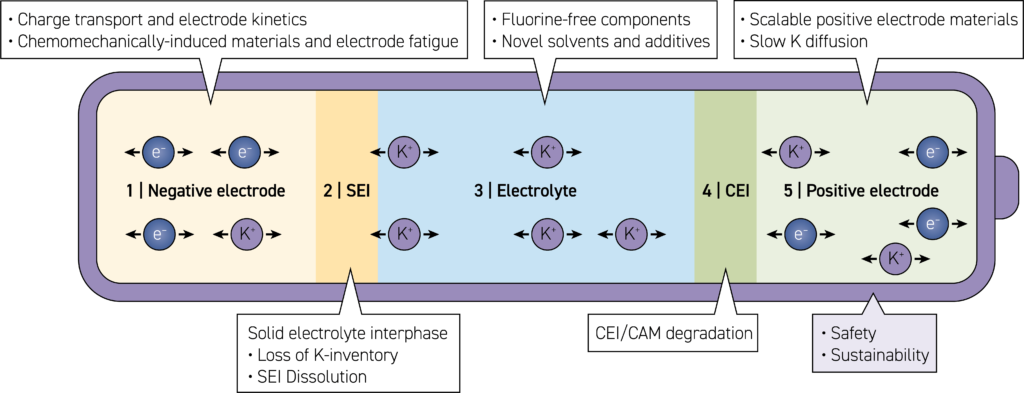
The transition from lab-scale experimentation to industrial-scale production is challenging, particularly for emerging battery chemistries like potassium-ion technology. POLiS has identified three critical hurdles for KIBs. First, reproducibility of results is challenging due to variability in material synthesis, cell assembly, and testing protocols. Second, material availability is limited and scaling up cathode active materials and electrolytes remains a bottleneck. And finally, performance optimization by understanding and mitigating irreversible capacity losses is essential for long-term stability. To tackle these issues, POLiS is developing reliable reference systems using upscaled cathode materials in small (coin cells) and medium-sized formats (pouch cells). This ensures standardized testing and comparable data across laboratories, fostering collaborative progress. By systematically addressing the challenges of potassium-ion batteries, POLiS is not only advancing fundamental science but also paving the way for their commercialization.