RU A.1
Sodium-Ion Batteries (SIBs) in POLiS II
Regarding post-lithium systems, SIBs already are the most developed ones, moving always closer toward market readiness. This Research Unit is dedicated to deliver large-format full-cells with beyond state-of-the-art performance and to reach fit-for-transfer SIBs, which can be directly further developed by industry. Our mission for sodium (Na) cell chemistry is to develop (i) a safe high-energy sodium-metal battery cell, and (ii) a truly sustainable, fluorine-free sodium-ion battery cell.
The focus will therefore be set on iron-containing layered oxides for positive electrode materials as well as on carbon and sodium-metal negative electrodes, investigated via a highly comprehensive, interdisciplinary approach. Additionally, zero-excess sodium-batteries with solid-state and quasi solid-state electrolytes will be brought to the fit-for-transfer level. Beyond the necessary expertise on the scaled-up synthesis of the cathode and anode materials, respectively developed within the Karlsruhe Institute of Technology (KIT) and the Ulm University, this research unit assembles a very broad pool of competences in the characterization techniques. At the Justus Liebig University (JLU) in Giessen, one may find for example word-class expertise in ToF-SIMS or XPS techniques to properly analyze interfaces and interphases, in well-balanced tandem with the simulation expertise at Ulm University and cell development at Karlsruhe Institute of Technology (KIT).
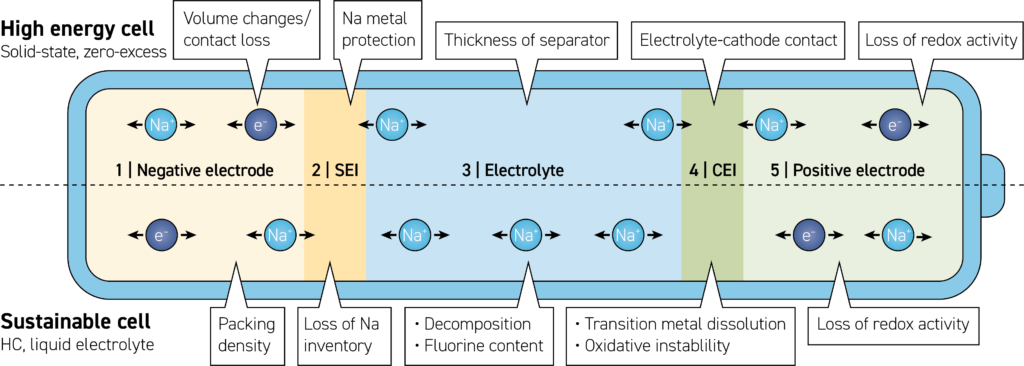
Using this important task force, the research programme of POLiS II aims to overcome roadblocks for commercializing SIBs by achieving a comprehensive understanding of the mechanisms responsible for drawbacks and shortcomings. Particularly interesting are the processes involved in the first charge process, which lead to an irreversible loss of about 15-20% in SIBs and should be overcome or at least mitigated. The knowledge of the detailed sodiation mechanism of hard carbons and the understanding of the relevant impact factors that enable a highly reversible sodium metal plating and stripping remain for example incomplete. The detailed understanding is impeded by the lack of reference materials, which our research programme will develop and synthesize in large scale, such as the prototype SIB cells from POLiS I, serving as benchmark systems. An important effort will be set on coordinating the production and delivery of the reference materials and electrodes, to ensure reproducibility and comparison of the results between the three partner sites.
To achieve these objectives, the programme is organized in line with the path of the ion inside the battery cell, by working on the insertion of Na ions into the negative electrode (causing volume changes/contact loss), then the SEI formation (loss of Na inventory), the transport of Na ions through the electrolyte and the separator, the CEI formation (loss of transition metal) and the de-insertion/de-intercalation of Na ions at the positive electrode (loss of redox activity).