RA C
Sustainability in POLiS II
Our mission for Researach Area C Sustainability is to establish a fully integrated technology‑assessment pipeline that follows a battery from raw‑material extraction, through material synthesis, cell‑level production (coin cell, test cell, pouch cell level) and use, to end‑of‑life and recycling. By embedding sustainability knowledge early in the design process, we can steer material and component choices toward the most resource‑efficient, low‑impact and safe concepts. After theoretical upscale towards industrial manufacturing, we can benchmark emerging post‑lithium chemistries against established commercial technologies.
During POLiS I, we introduced the first systematic sustainability‑screening methodology for sodium‑ion cathodes, performed prospective life‑cycle‑assessment for magnesium‑sulfur, and demonstrated how quantitative life‑cycle‑costing can guide material selection. It is demonstrated that economic, environmental and social factors must be evaluated together and laid the groundwork for a common “Sustainability Toolbox” that now includes prospective LCA, LCC, social‑LCA, multi‑criteria decision analysis and ‑ toxicity hazard‑screening (SSbD approach). Thus, within POLiS II, a TRL dependent multidimensional assessment will be developed to support sustainable development from the beginning along the full value chain.
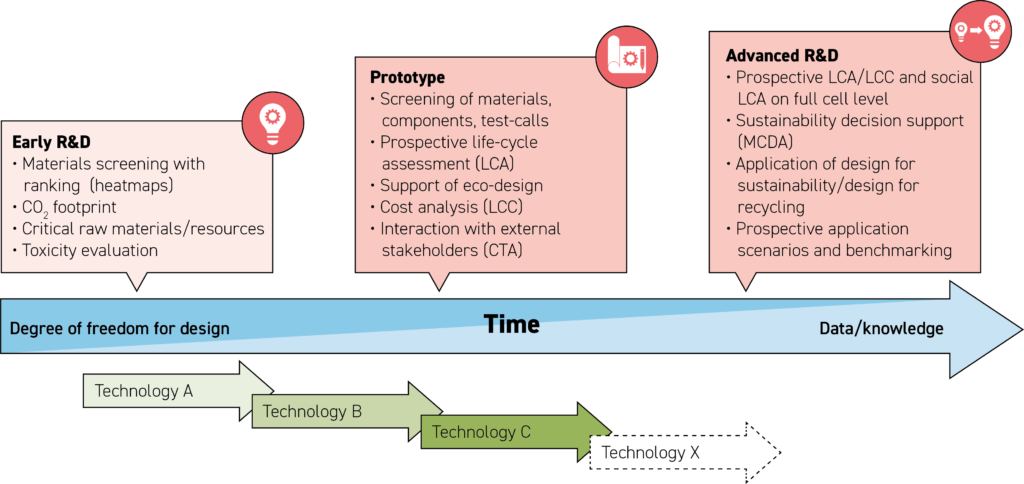
A central challenge is to achieve holistic life cycle coverage, quantifying carbon‑footprint, critical‑element demand, toxicity, recyclability and safety for every material, electrolyte, binder and processing step without creating burden‑shifting elsewhere in the chain. It is planned to support high‑throughput synthesis and AI‑driven discovery with rapid sustainability evaluation so that only the most promising candidates proceed to scale‑up. Prospective assessment will require digital twins of cells, supplied by the POLiS Data Hub, to deliver performance forecasts that feed directly into LCA and LCC models, enabling design‑ decisions before a prototype is built. Alignment with EU regulations, such as the Battery Passport, the Battery Regulation and the “Safe and Sustainable by Design (SSbD)” framework will be embedded in our methodology, guaranteeing that new concepts meet present and future legal and societal expectations. Finally, the results will provide decision‑support for material scientists, and cell engineers, and feed back into the POLiS Lab for benchmark testing.
Our approach will be implemented in three stages. In the first stage, we will develop streamlined assessment methods at low TRL level of different chemistries to identify sustainability hotspots. This can be also integrated into Research Area B’s high‑throughput pipelines. The second stage will expand the screening to full component suites (on coin or test cell level) – including active materials, electrolytes, binders and additives – across e.g. sodium, potassium, magnesium, calcium, aluminium and chloride chemistries, supported by multi‑criteria decision analysis to consider performance, cost and environmental impact and identify goal conflicts. The third stage will conduct full‑cell cradle‑to‑grave LCA, LCC and social‑LCA for demonstrator and pilot‑scale cells, exploit digital‑twin predictions and hotspots for improvement. Developed recycling processes for different chemistries within POLIS II will be analyzed and compared with state of the art.
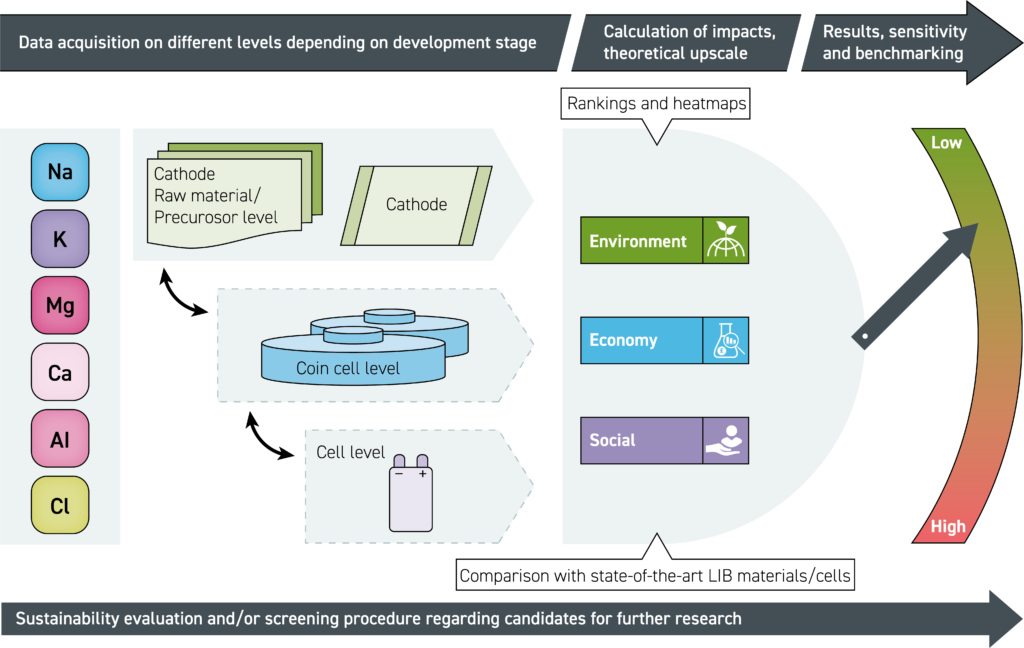
and full cell systems of different battery chemistries.
We expect to deliver publicly available, FAIR‑compliant sustainability data for post‑lithium batteries, decision‑support tools that eliminate high‑impact materials before scale‑up, and demonstrator cells that meet EU sustainability criteria and support next steps towards industry scale manufacturing. By linking sustainability insights with material discovery, data science and accelerated cell production, we support the development of high-performance new battery cell concepts, which are evaluated and optimized regarding their sustainability profile.