An Integrated Research Programme for Sustainable Post-Lithium Batteries
The development of sustainable post-lithium batteries requires a research programme that combines scientific depth with interdisciplinary collaboration. At POLiS, researchers from a broad range of disciplines work together to discover entirely new battery chemistries, understand their fundamental mechanisms and translate scientific insights into functional full-cell demonstrators.
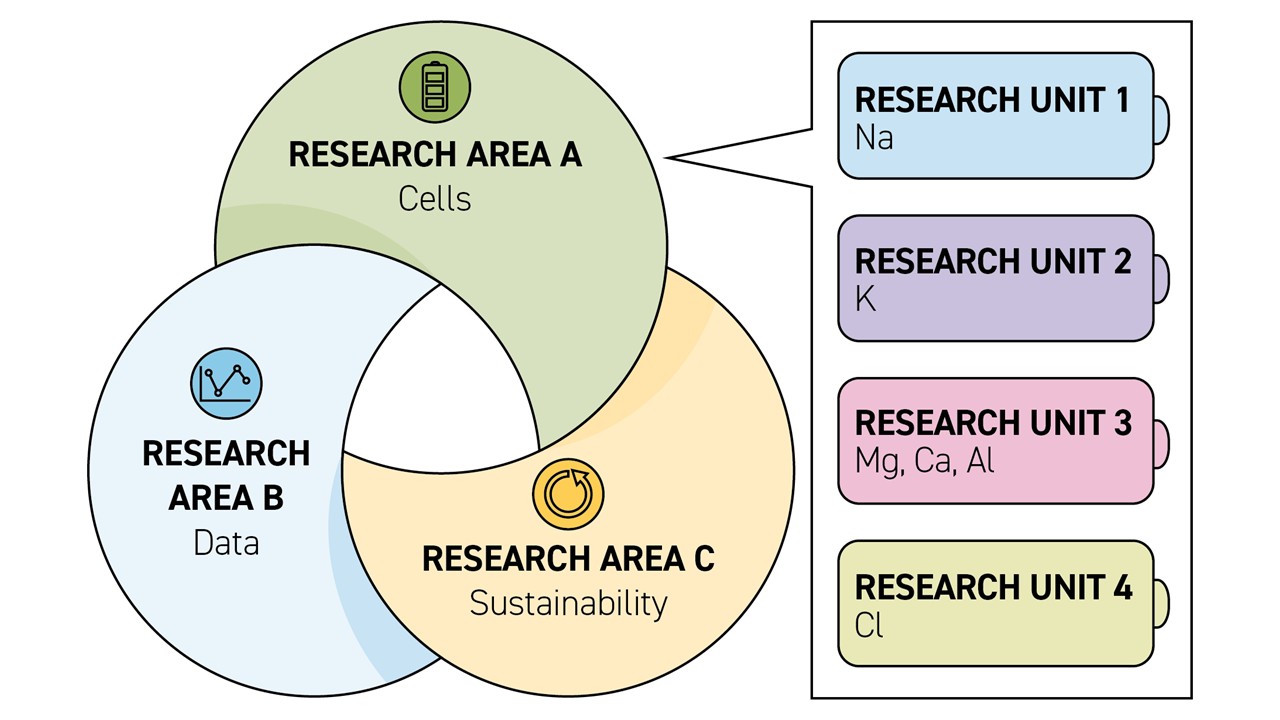
The research programme is organised into Research Units (RUs) and Research Areas (RAs) that together form an integrated scientific framework. Each Research Unit addresses a specific scientific challenge, while the Research Areas connect complementary research activities towards a common goal: establishing the scientific foundations of the next generation of sustainable battery technologies.
Research Area A
Research Area A – Exploring New Battery Chemistries
Research Area A forms the scientific core of POLiS. It investigates four promising classes of post-lithium batteries, each represented by a dedicated Research Unit:
- RU A.1 – Sodium Batteries
- RU A.2 – Potassium Batteries
- RU A.3 – Multivalent Batteries
- RU A.4 – Chloride Batteries
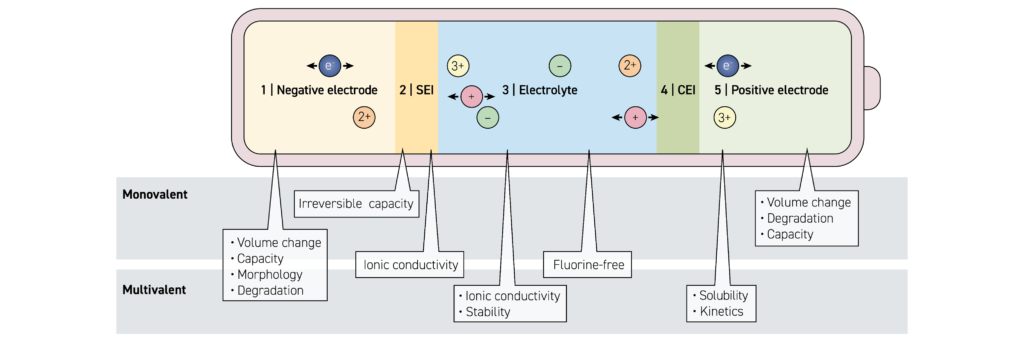
Each Research Unit addresses the unique scientific questions associated with its respective chemistry families while pursuing the shared objective of developing viable alternatives to lithium-ion technology. Together, these complementary approaches broaden the search for future battery systems and create opportunities to identify new electrochemical concepts.
Research Area B
Research Area B – Data
Scientific discovery is increasingly driven by data. Research Area B develops the digital methods and computational tools that support and accelerate battery research across the entire Cluster.
Its activities span the full spectrum from research data management and FAIR data principles to data science, multiscale simulation, machine learning, automation and high-throughput methodologies. By integrating experimental data, theoretical models and digital workflows, Research Area B enables faster materials discovery, deeper scientific understanding and more efficient research processes throughout POLiS.
Research Area C
Research Area C – Sustainability
Future batteries must not only deliver excellent performance but also meet the highest standards of sustainability, safety and resource efficiency. Research Area C therefore accompanies the development of new battery chemistries from the earliest stages of research.
By assessing environmental impacts, resource availability, manufacturing processes, circularity and safety, sustainability becomes an integral design criterion rather than a final evaluation step. This systems perspective ensures that promising battery concepts are developed with their entire life cycle in mind.
Cross-sectional Topics
Working Together Across Research Areas
Although each Research Area has its own scientific focus, the strength of POLiS lies in their close integration. Research Areas B and C interact continuously with all four chemistry-centred Research Units, providing digital tools, theoretical models and sustainability assessments that guide experimental research and accelerate scientific progress.
This creates an iterative research process in which theory, simulation, experimentation, data analysis and sustainability assessment continuously inform one another. Insights gained from functional full-cell demonstrators feed back into the design of new materials, improved models and refined sustainability concepts, creating a continuous cycle of scientific discovery.