Ulm | Karlsruhe | Giessen
Three Universities – One Shared Vision
Scientific excellence thrives on complementary expertise and close collaboration. POLiS brings together three leading German research universities with a shared commitment to advancing sustainable post-lithium energy storage. By combining strengths in fundamental science, engineering, data-driven research and technology development, the partners create a unique interdisciplinary research environment that spans the entire innovation pathway – from fundamental understanding to functional full-cell demonstrators.
Together, Ulm University, Karlsruhe Institute of Technology (KIT) and Justus Liebig University Giessen (JLU) contribute outstanding scientific expertise, state-of-the-art research infrastructure and a strong culture of collaboration. This close partnership enables POLiS to address the complex scientific challenges of next-generation batteries from multiple perspectives and across institutional boundaries.
Ulm University
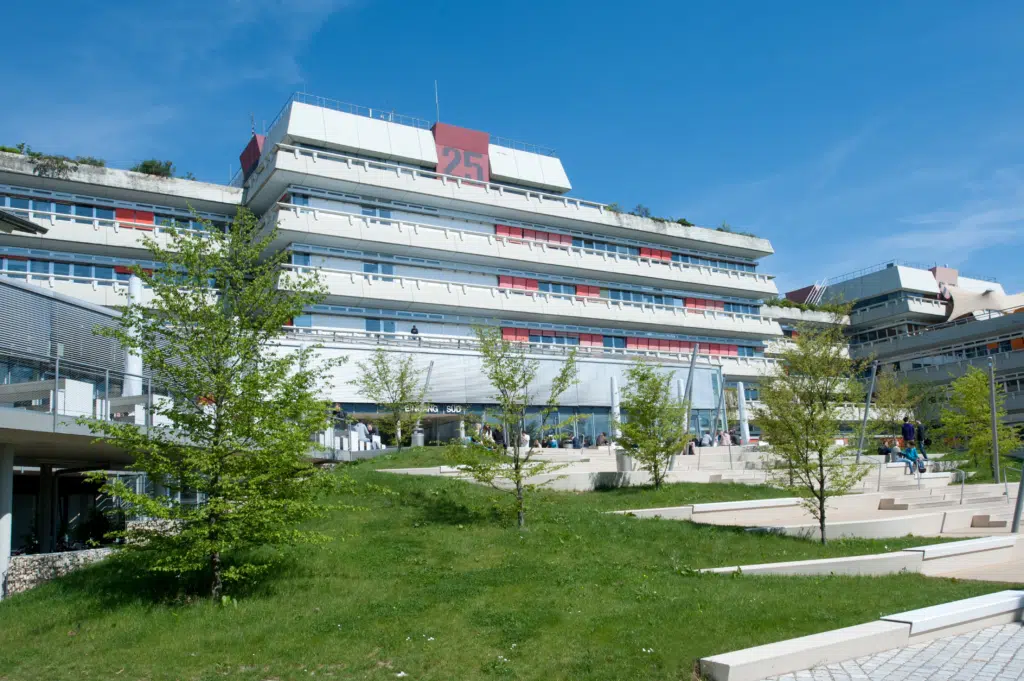
Founded in 1967, Ulm University is a research-intensive institution with over 10,000 students across four faculties and more than 60 degree programmes. As a key driver of the Science City of Ulm, it fosters collaboration between academia, research institutes, hospitals and industry. Its research focuses on energy storage, quantum technologies, and AI, with internationally recognised excellence in battery research through the POLiS Cluster of Excellence. Together with leading partners, Ulm University develops sustainable energy storage solutions, supported by advanced laboratories and high-performance computing infrastructure to accelerate innovation and technology transfer.

Karlsruhe Institute of Technology
Karlsruhe Institute of Technology (KIT) uniquely combines a leading technical university with a major large-scale research institution, advancing sustainable solutions to global challenges through interdisciplinary research and education. Its expertise spans engineering, natural sciences, humanities, and social sciences, covering the full spectrum from fundamental to applied, industry-oriented research. Guided by excellence and scientific integrity, KIT fosters international collaboration, research-based teaching, and early student involvement in interdisciplinary projects. Through innovation, entrepreneurship, and strong links with industry, KIT promotes the development of impactful technologies while encouraging creativity and the exchange of knowledge on a global scale.
Justus Liebig University Giessen
Founded in 1607, Justus Liebig University Giessen (JLU) is a comprehensive university with around 25,000 students and a strong reputation for interdisciplinary research. It is a leading centre for One Health research, integrating human and veterinary medicine with agricultural, environmental, nutritional, and food sciences to address global health challenges. JLU also excels in perception, heart-lung, and battery research, supported by Germany’s Excellence Strategy. With strengths across the humanities, sciences, and medicine, the university combines internationally recognised research with a strong commitment to education, innovation, and societal impact.
